COURSE

AI Security Lifecycle – Test and Evaluate

Course

This course provides a comprehensive and in-depth examination of the principles, frameworks, and methodologies required to test, evaluate, and secure artificial intelligence systems across their entire lifecycle.

Full access included with 
Insider Pro
 and 
Teams

3

H

5

M
Time

Intermediate

i
Designed for learners who have no prior work experience in IT or Cybersecurity, but are interested in starting a career in this exciting field.
Designed for learners with prior cybersecurity work experience who are interested in advancing their career or expanding their skillset.
Designed for learners with a solid grasp of foundational IT and cybersecurity concepts who are interested in pursuing an entry-level security role.
Experience Level

133

Enrollees

2000

XP

3

i

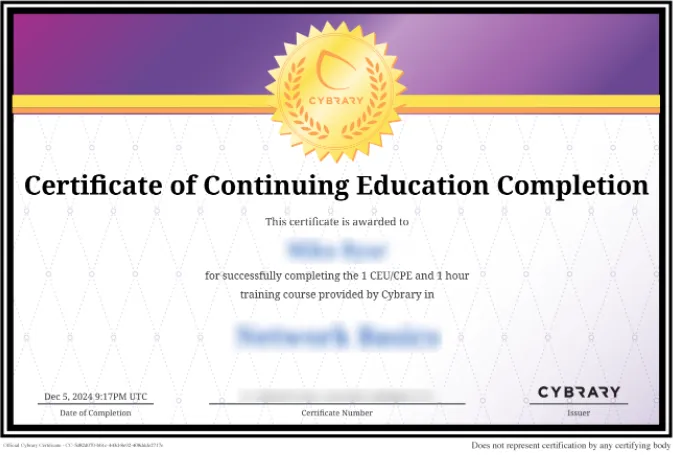
Earn qualifying credits for certification renewal with completion certificates provided for submission.
CEU's

Learners at 96% of Fortune 1000 companies trust Cybrary

About this course

Read More

Skills you'll gain

Course Outline

1
Module 1: AI Security Lifecycle – Test and Evaluate
3
H
5
Min

1.1 Foundations of AI Testing & Evaluation

Free

200 XP

H

10m

1.2 Adversarial Testing Methodologies in AI Systems

Free

200 XP

H

15m

1.3 AI Red Teaming Practices

Free

200 XP

H

20m

1.4 Bias and Fairness Evaluation in AI Systems

Free

200 XP

H

20m

1.5 Vulnerability Assessment & Penetration Testing (VAPT) for AI Systems

Free

200 XP

H

20m

1.6 Security Orchestration in AI Testing

Free

200 XP

H

20m

1.7 Model Benchmarking & Performance Evaluation in AI Systems

Free

200 XP

H

20m

1.8 Final Audit and Certification of AI Models

Free

200 XP

H

20m

1.9 AI Security Testing Framework (Layered Approach

Free

200 XP

H

20m

1.10 Real-World Testing Case Studies in AI Security and Evaluation

Free

200 XP

H

20m

1.1 Foundations of AI Testing & Evaluation

10m

Module 1: AI Security Lifecycle – Test and Evaluate
1.2 Adversarial Testing Methodologies in AI Systems

15m

Module 1: AI Security Lifecycle – Test and Evaluate
1.3 AI Red Teaming Practices

20m

Module 1: AI Security Lifecycle – Test and Evaluate
1.4 Bias and Fairness Evaluation in AI Systems

20m

Module 1: AI Security Lifecycle – Test and Evaluate
1.5 Vulnerability Assessment & Penetration Testing (VAPT) for AI Systems

20m

Module 1: AI Security Lifecycle – Test and Evaluate
1.6 Security Orchestration in AI Testing

20m

Module 1: AI Security Lifecycle – Test and Evaluate
1.7 Model Benchmarking & Performance Evaluation in AI Systems

20m

Module 1: AI Security Lifecycle – Test and Evaluate
1.8 Final Audit and Certification of AI Models

20m

Module 1: AI Security Lifecycle – Test and Evaluate
1.9 AI Security Testing Framework (Layered Approach

20m

Module 1: AI Security Lifecycle – Test and Evaluate
1.10 Real-World Testing Case Studies in AI Security and Evaluation

20m

Module 1: AI Security Lifecycle – Test and Evaluate
Course Description

The “AI Security Lifecycle – Testing and Evaluation” course provides a comprehensive and in-depth examination of the principles, frameworks, and methodologies required to test, evaluate, and secure artificial intelligence systems across their entire lifecycle. As AI technologies continue to transform industries such as healthcare, finance, utilities, telecommunications, and enterprise automation, the need for structured testing and evaluation has become critical to ensure reliability, fairness, robustness, and security. Unlike traditional software systems, AI models are probabilistic, data-driven, and continuously evolving, which introduces unique risks including bias, adversarial manipulation, model drift, data leakage, and governance challenges. This course is designed to equip learners with the theoretical foundations and practical knowledge necessary to address these risks through rigorous and lifecycle-oriented AI testing strategies.

The course begins by establishing the foundations of AI testing and evaluation, emphasizing the importance of continuous validation throughout data collection, model development, deployment, and post-production monitoring. It explores how effectiveness, fairness, and resilience form the core pillars of trustworthy AI systems and highlights the differences between traditional quality assurance and AI-specific testing approaches. Learners gain insight into ethical validation, security assessment, and real-world testing considerations that are essential before deploying AI models in high-stakes environments.

Building on these foundations, the course examines advanced adversarial testing methodologies, including adversarial input generation, malicious prompt stress testing, prompt injection analysis, and robustness evaluation under manipulated conditions. It further introduces AI red teaming practices that simulate real-world attack scenarios, social engineering threats, and multi-step adversarial interactions, particularly in large language models and conversational AI systems. These modules enable learners to understand how proactive threat simulation strengthens AI security posture and system resilience.

The curriculum also provides extensive coverage of bias and fairness evaluation, including bias detection in training datasets, fairness metrics such as demographic parity and equalized odds, and the use of model fairness frameworks to support ethical AI validation. In addition, the course addresses Vulnerability Assessment and Penetration Testing (VAPT) for AI systems, focusing on attack surface analysis, API security testing, infrastructure vulnerability assessments, dependency risk analysis, and secure data flow validation in complex AI architectures.

A key component of the course is security orchestration in AI testing, where learners explore the integration of Security Orchestration, Automation, and Response (SOAR), centralized security dashboards, log and alert correlation, automated remediation workflows, and continuous monitoring integration. The course also delves into model benchmarking and performance evaluation, covering accuracy benchmarking, robustness testing, compliance benchmarking, comparative model evaluation, and reliability testing frameworks to ensure operational readiness and regulatory alignment.

Finally, the course addresses final audit and certification of AI models, governance and regulatory alignment, and real-world testing case studies involving red teaming, sensitive data leakage testing, input sanitization validation, context filtering, and post-deployment continuous evaluation. Overall, this course provides a holistic, governance-driven, and security-focused approach to AI testing and evaluation, enabling professionals to design, audit, and deploy trustworthy, compliant, and production-ready AI systems in dynamic and adversarial real-world environments.

Course Objectives

  • Explain the role of testing and evaluation as foundational components of the AI lifecycle.
  • Differentiate between traditional software quality assurance and AI-specific testing methodologies.
  • Evaluate AI systems for effectiveness, fairness, robustness, and resilience.
  • Apply adversarial testing techniques to identify vulnerabilities in AI models and agents.
  • Conduct AI red teaming exercises that simulate real-world and adversarial threat scenarios.
  • Assess bias in training datasets and apply fairness metrics such as demographic parity and equalized odds.
  • Implement bias mitigation strategies including data rebalancing, algorithmic tuning, and human oversight.
  • Perform Vulnerability Assessment and Penetration Testing (VAPT) for AI systems across models, APIs, and infrastructure.
  • Analyze AI attack surfaces including data pipelines, model endpoints, and third-party integrations.
  • Utilize security orchestration concepts such as SOAR, log correlation, and automated remediation workflows.
  • Benchmark AI model performance using accuracy, robustness, compliance, and reliability evaluation frameworks.
  • Design lifecycle-based continuous monitoring and feedback loops for post-deployment AI systems.
  • Validate ethical, regulatory, and governance requirements during AI model audits and certification processes.
  • Interpret real-world AI testing case studies related to prompt injection, data leakage, and context filtering.
  • Develop comprehensive, layered AI security testing frameworks for secure and trustworthy AI deployment.

Train Your Team

Cybrary’s expert-led cybersecurity courses help your team remediate skill gaps and get up-to-date on certifications. Utilize Cybrary to stay ahead of emerging threats and provide team members with clarity on how to learn, grow, and advance their careers within your organization.

Included in a Path

No items found.
No items found.

Instructors

Raghu Bala
Cybrary Instructor
Read Full Bio
Learn

Learn core concepts and get hands-on with key skills.

Practice

Exercise your problem-solving and creative thinking skills with security-centric puzzles

Prove

Assess your knowledge and skills to identify areas for improvement and measure your growth

Get Hands-on Learning

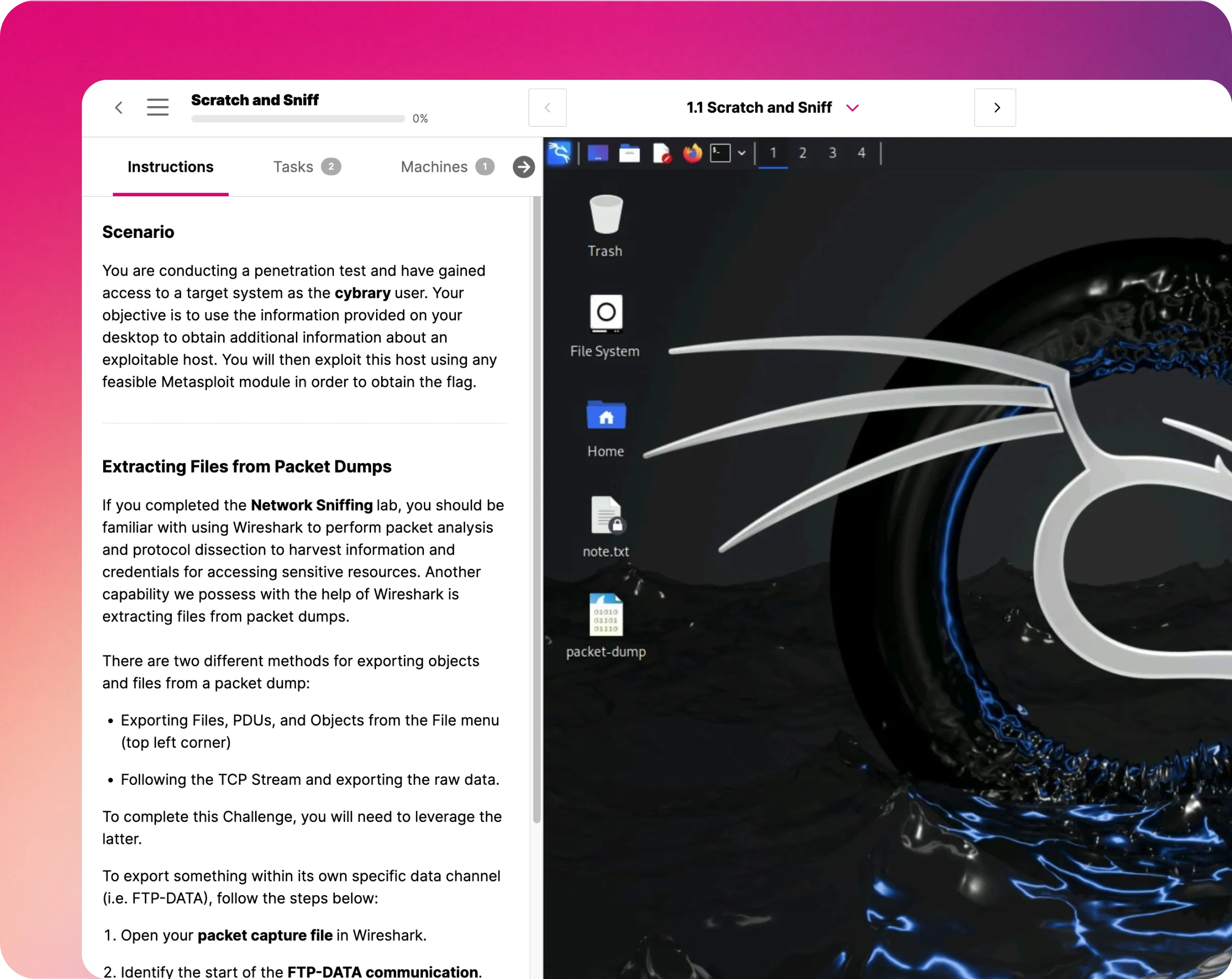
Put your skills to the test in virtual labs, challenges, and simulated environments.

Measure Your Progress

Track your skills development from lesson to lesson using the Cybrary Skills Tracker.

Connect with the Community

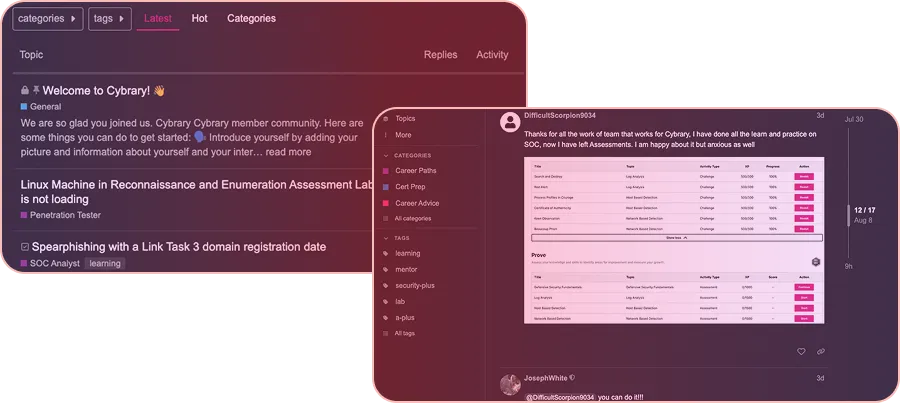
Connect with peers and mentors through our supportive community of cybersecurity professionals.

Success from Our Learners

"Cybrary really helped me get up to speed and acquire a baseline level of technical knowledge. It offers a far more comprehensive approach than just learning from a book. It actually shows you how to apply cybersecurity processes in a hands-on way"

Don Gates

Principal Systems Engineer/SAIC

"Cybrary’s SOC Analyst career path was the difference maker, and was instrumental in me landing my new job. I was able to show the employer that I had the right knowledge and the hands-on skills to execute the role."

Cory

Cybersecurity analyst/

"I was able to earn my CISSP certification within 60 days of signing up for Cybrary Insider Pro and got hired as a Security Analyst conducting security assessments and penetration testing within 120 days. This certainly wouldn’t have been possible without the support of the Cybrary mentor community."

Mike

Security Engineer and Pentester/

"Cybrary really helped me get up to speed and acquire a baseline level of technical knowledge. It offers a far more comprehensive approach than just learning from a book. It actually shows you how to apply cybersecurity processes in a hands-on way"

Don Gates

Principal Systems Engineer/SAIC

"Cybrary’s SOC Analyst career path was the difference maker, and was instrumental in me landing my new job. I was able to show the employer that I had the right knowledge and the hands-on skills to execute the role."

Cory

Cybersecurity analyst/

"I was able to earn my CISSP certification within 60 days of signing up for Cybrary Insider Pro and got hired as a Security Analyst conducting security assessments and penetration testing within 120 days. This certainly wouldn’t have been possible without the support of the Cybrary mentor community."

Mike

Security Engineer and Pentester/

"Becoming a Cybrary Insider Pro was a total game changer. Cybrary was instrumental in helping me break into cybersecurity, despite having no prior IT experience or security-related degree. Their career paths gave me clear direction, the instructors had real-world experience, and the virtual labs let me gain hands-on skills I could confidently put on my resume and speak to in interviews."

Cassandra

Information Security Analyst/Cisco Systems

"I was able to earn both my Security+ and CySA+ in two months. I give all the credit to Cybrary. I’m also proud to announce I recently accepted a job as a Cyber Systems Engineer at BDO... I always try to debunk the idea that you can't get a job without experience or a degree."

Casey

Cyber Systems Engineer/BDO

"Cybrary has helped me improve my hands-on skills and pass my toughest certification exams, enabling me to achieve 13 advanced certifications and successfully launch my own business. I love the practice tests for certification exams, especially, and appreciate the wide-ranging training options that let me find the best fit for my goals"

Angel

Founder,/ IntellChromatics.

AI Security Lifecycle – Test and Evaluate

This course provides a comprehensive and in-depth examination of the principles, frameworks, and methodologies required to test, evaluate, and secure artificial intelligence systems across their entire lifecycle.

3
5
M
Time
Intermediate
difficulty
3
ceu/cpe

Course Content

Course Description

The “AI Security Lifecycle – Testing and Evaluation” course provides a comprehensive and in-depth examination of the principles, frameworks, and methodologies required to test, evaluate, and secure artificial intelligence systems across their entire lifecycle. As AI technologies continue to transform industries such as healthcare, finance, utilities, telecommunications, and enterprise automation, the need for structured testing and evaluation has become critical to ensure reliability, fairness, robustness, and security. Unlike traditional software systems, AI models are probabilistic, data-driven, and continuously evolving, which introduces unique risks including bias, adversarial manipulation, model drift, data leakage, and governance challenges. This course is designed to equip learners with the theoretical foundations and practical knowledge necessary to address these risks through rigorous and lifecycle-oriented AI testing strategies.

The course begins by establishing the foundations of AI testing and evaluation, emphasizing the importance of continuous validation throughout data collection, model development, deployment, and post-production monitoring. It explores how effectiveness, fairness, and resilience form the core pillars of trustworthy AI systems and highlights the differences between traditional quality assurance and AI-specific testing approaches. Learners gain insight into ethical validation, security assessment, and real-world testing considerations that are essential before deploying AI models in high-stakes environments.

Building on these foundations, the course examines advanced adversarial testing methodologies, including adversarial input generation, malicious prompt stress testing, prompt injection analysis, and robustness evaluation under manipulated conditions. It further introduces AI red teaming practices that simulate real-world attack scenarios, social engineering threats, and multi-step adversarial interactions, particularly in large language models and conversational AI systems. These modules enable learners to understand how proactive threat simulation strengthens AI security posture and system resilience.

The curriculum also provides extensive coverage of bias and fairness evaluation, including bias detection in training datasets, fairness metrics such as demographic parity and equalized odds, and the use of model fairness frameworks to support ethical AI validation. In addition, the course addresses Vulnerability Assessment and Penetration Testing (VAPT) for AI systems, focusing on attack surface analysis, API security testing, infrastructure vulnerability assessments, dependency risk analysis, and secure data flow validation in complex AI architectures.

A key component of the course is security orchestration in AI testing, where learners explore the integration of Security Orchestration, Automation, and Response (SOAR), centralized security dashboards, log and alert correlation, automated remediation workflows, and continuous monitoring integration. The course also delves into model benchmarking and performance evaluation, covering accuracy benchmarking, robustness testing, compliance benchmarking, comparative model evaluation, and reliability testing frameworks to ensure operational readiness and regulatory alignment.

Finally, the course addresses final audit and certification of AI models, governance and regulatory alignment, and real-world testing case studies involving red teaming, sensitive data leakage testing, input sanitization validation, context filtering, and post-deployment continuous evaluation. Overall, this course provides a holistic, governance-driven, and security-focused approach to AI testing and evaluation, enabling professionals to design, audit, and deploy trustworthy, compliant, and production-ready AI systems in dynamic and adversarial real-world environments.

Course Objectives

  • Explain the role of testing and evaluation as foundational components of the AI lifecycle.
  • Differentiate between traditional software quality assurance and AI-specific testing methodologies.
  • Evaluate AI systems for effectiveness, fairness, robustness, and resilience.
  • Apply adversarial testing techniques to identify vulnerabilities in AI models and agents.
  • Conduct AI red teaming exercises that simulate real-world and adversarial threat scenarios.
  • Assess bias in training datasets and apply fairness metrics such as demographic parity and equalized odds.
  • Implement bias mitigation strategies including data rebalancing, algorithmic tuning, and human oversight.
  • Perform Vulnerability Assessment and Penetration Testing (VAPT) for AI systems across models, APIs, and infrastructure.
  • Analyze AI attack surfaces including data pipelines, model endpoints, and third-party integrations.
  • Utilize security orchestration concepts such as SOAR, log correlation, and automated remediation workflows.
  • Benchmark AI model performance using accuracy, robustness, compliance, and reliability evaluation frameworks.
  • Design lifecycle-based continuous monitoring and feedback loops for post-deployment AI systems.
  • Validate ethical, regulatory, and governance requirements during AI model audits and certification processes.
  • Interpret real-world AI testing case studies related to prompt injection, data leakage, and context filtering.
  • Develop comprehensive, layered AI security testing frameworks for secure and trustworthy AI deployment.
This course is part of a Career Path:
No items found.

Instructed by

Provider
Cybrary Logo
Certification Body
Certificate of Completion

Complete this entire course to earn a AI Security Lifecycle – Test and Evaluate Certificate of Completion